챔피언을 고르기 전에 두 전적 사이트를 열었는데 순위가 다르다면 어느 쪽이 틀렸다고 결론 내리기 전에 필터를 맞춰 보자. 한쪽은 전체 지역의 최근 30일, 다른 쪽은 한국 서버의 현 패치를 보여 줄 수 있다. 같은 챔피언 이름만 확인한 비교로는 실제 차이를 설명할 수 없다. 다음은 특정 챔피언을 추천하는 순위표가 아니라 이용자가 직접 통계를 점검하는 순서다.
첫 화면에서 여섯 칸을 기록한다
먼저 패치, 집계 기간, 서버, 랭크 구간, 역할, 게임 모드를 적는다. 이어 전체 경기 수와 관심 있는 세부 항목의 표본 수를 따로 확인한다. 챔피언 전체 기록이 많아도 특정 상대·아이템 조합에 해당하는 기록은 매우 적을 수 있다. 마지막으로 조회 시각을 남긴다. 계속 갱신되는 표를 다른 시간에 열어 숫자가 달라졌다고 오류로 판단하지 않기 위해서다.
비교 칸
기록 예시의 성격
확인할 질문
패치·기간
현 패치 또는 최근 며칠
이전 밸런스 기록이 섞였나
서버
한국 또는 전체 지역
플레이 환경이 같은가
등급
골드, 에메랄드 이상 등
같은 실력 구간을 골랐나
역할·모드
미드, 개인·2인 랭크 등
다른 역할이나 모드가 섞였나
표본
전체와 세부 조합 각각
실제로 몇 기록을 비교하나
조회 시각
날짜와 시간
갱신 차이를 고려했나
예시는 선택 항목을 설명하기 위한 것이며 모든 사이트가 같은 메뉴를 제공한다는 뜻은 아니다. 특정 필터를 제공하지 않거나 계산 시점을 설명하지 않는다면 그 부분은 비교 불가로 남겨야 한다. 빈칸을 추정값으로 채우면 더 정밀한 비교가 되는 것이 아니다.
60%라는 숫자 옆에 경기 수를 붙인다
가상의 챔피언 가가 10경기에서 6승, 나가 1,000경기에서 600승을 기록했다면 둘 다 60%다. 하지만 가가 한 번 더 지면 약 54.5%, 나는 한 번 더 져도 약 59.9%다. 작은 표본의 높은 승률을 그대로 최상위 추천으로 바꾸면 다음 몇 경기만으로 평가가 크게 달라질 수 있다.
표본이 충분하다는 기준도 하나로 고정하기 어렵다. 전체 승률, 특정 상대와의 승률, 세 번째 아이템을 완성한 경기만의 승률은 서로 다른 질문이다. 작은 하위 집단으로 나눌수록 다시 표본 수를 확인해야 한다. 전체 페이지 상단에 적힌 큰 경기 수를 세부 조합의 근거로 대신 써서는 안 된다.
아이템 승률에서는 선택 조건도 생각해야 한다. 비싼 후반 아이템을 완성할 수 있었던 경기만 모았다면 초반에 끝난 경기는 빠진다. 높은 승률이 아이템 자체의 효과만을 보여 주는지, 이미 유리해서 그 아이템을 살 수 있었던 것인지 표만으로 분리하기 어렵다. 이는 가상의 해석 예시이며 특정 아이템이 좋거나 나쁘다는 판정이 아니다.
전체 경기 수와 조건을 좁힌 조합의 경기 수는 다르다. 지정 GPTs로 제작한 인공지능 설명 이미지이며 실제 현장 사진이 아닙니다.
원 승률과 보정 순위는 다른 열로 읽는다
LegendsTracker는 작은 표본의 극단값을 완화하기 위해 관측 승률을 기준값 쪽으로 당기는 방식을 공개한다. 공개 식에서 보정 강도는 150이며 전체 구간 기준값은 50%, 단일 랭크는 해당 목록의 평균을 사용한다. 표본의 불확실성을 고려해 승률 추정 구간의 아래쪽 경계인 95% 윌슨 하한도 반영한다고 설명한다. 이는 운영자가 공개한 방법이며 독립적인 정확도 인증은 아니다. 방법론 원문
보정 후 표시값을 실제로 이긴 경기의 비율과 혼동하지 않아야 한다. 또한 그 문서의 ‘후보 챔피언 풀이 5개 이하이면 최상위 등급을 주지 않는다’는 제한은 ‘5경기 이하인 챔피언’이라는 말과 다르다. 비교 대상의 개수와 한 챔피언의 표본 수는 다른 조건이다.
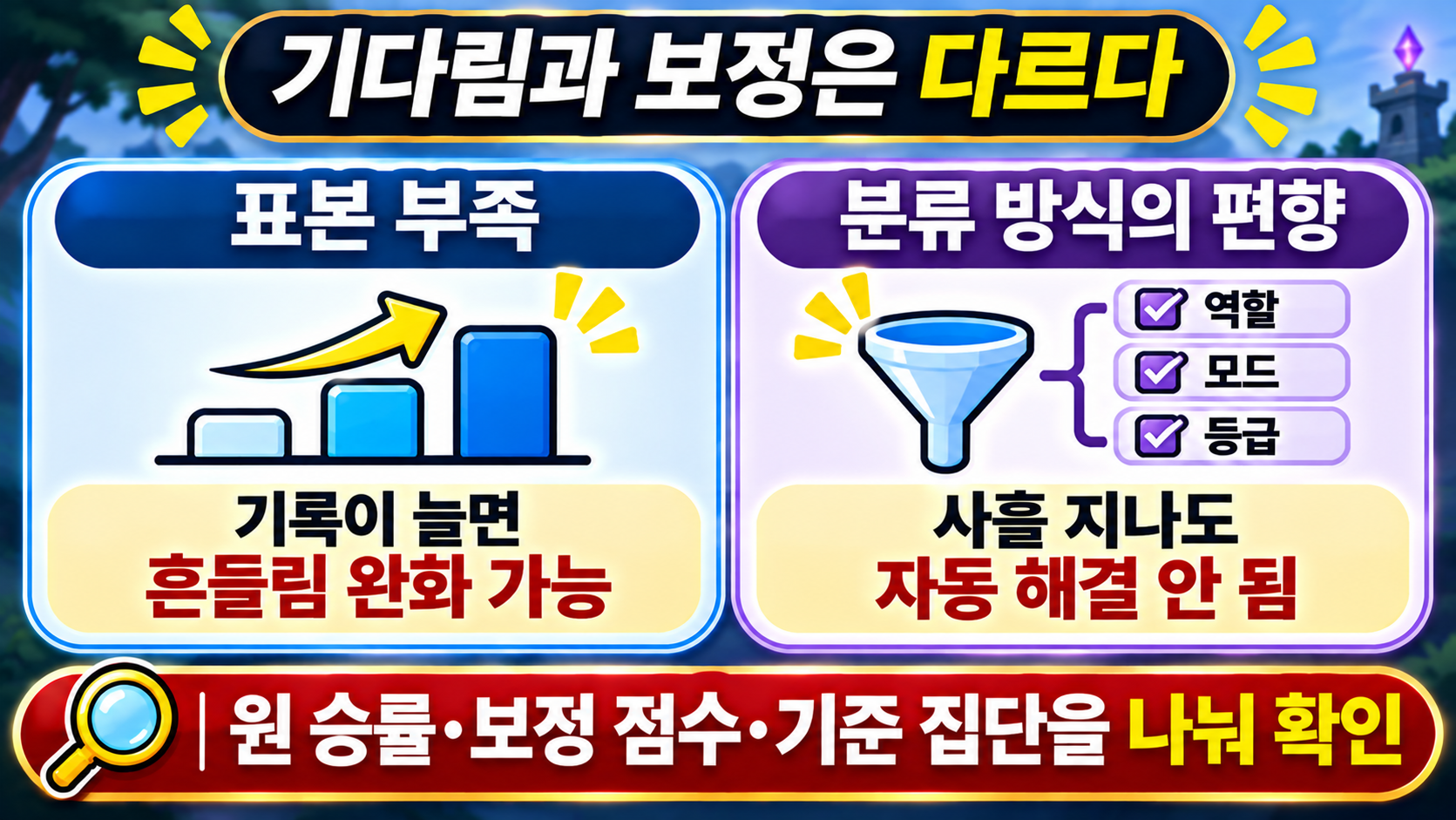
이용자가 살필 질문은 세 가지다. 화면의 숫자가 원 승률인지 계산 점수인지, 보정에 쓴 기준 집단이 무엇인지, 작은 표본에 어떤 제한을 두는지다. 설명이 없다면 점수의 소수점까지 비교해 정교한 차이라고 단정하기 어렵다. 순위표에서 한 칸 위라는 이유만으로 자신의 숙련도 차이가 사라지지도 않는다.
패치 사흘 뒤면 믿어도 된다는 규칙은 없다
커뮤니티 분석 작성자는 패치 16.17 등 일부 기록에서 현재 등급으로 이전 경기를 재분류할 때 발생할 수 있는 편향을 지적했다. 승급한 선수의 과거 승리와 강등한 선수의 과거 패배가 어느 집단에 들어가는지가 쟁점이다. 해당 분석을 모든 서비스·현재 패치에 대한 확정 판정으로 확대해서는 안 된다. 작성자의 원 분석
시간이 지나 기록이 늘어나는 효과와 분류 방식은 따로 봐야 한다. 사흘을 기다리면 표본이 늘 수는 있어도 잘못된 분류가 자동 교정되지는 않는다. 반대로 새 패치 첫날의 승률 하락을 모두 실제 성능 하락으로 단정할 수도 없다. 게임 내 변경 사항, 표본 구성과 관측 기간을 함께 확인해야 한다.
상성표도 단순 승률인지 평균 대비 차이인지 먼저 확인한다. 2%와 2%포인트는 다른 표현이다. 승률이 50%에서 52%로 바뀌면 차이는 2%포인트, 상대 증가율은 4%다. 특정 사이트의 상성 점수가 양수라는 이유만으로 무조건 유리하다고 읽거나, 다른 표의 기준값을 그대로 빼는 계산은 피해야 한다.
표본 증가와 분류 편향의 보정은 구분해야 한다. 지정 GPTs로 제작한 인공지능 설명 이미지이며 실제 현장 사진이 아닙니다.
설치형 도구는 별도로 규정을 점검한다
웹에서 통계를 참고하는 것과 경기 중 보조 프로그램을 쓰는 것은 같은 작업이 아니다. 라이엇의 롤 개발 문서는 클라이언트에 없는 정보로 경쟁 우위를 주거나 플레이어의 선택을 대신하는 제품을 제한한다. 공식 실력 순위를 대체하는 계산과 숨겨진 플레이어 식별도 허용 범위를 벗어날 수 있다. 라이엇 롤 개발 문서
오버울프의 준수 안내는 적의 능력·소환사 주문 타이머, 레벨 변화에 따른 행동 지시 등을 제한 사례로 설명한다. 현재 앱이 제공하는 기능과 공식 안내를 대조해야 한다. 유명하거나 다운로드 수가 많다는 사실만으로 개별 기능의 허용을 판단할 수 없다. 오버울프 안내
실제로 앱을 고를 때는 배포 주체, 필요한 권한, 계정 연동 해제와 삭제 방법을 먼저 확인하자. 규정과 다른 기능을 제공한다는 의심이 들면 숨겨서 사용하거나 제한을 우회하는 방법을 찾지 말고 개발사에 기능 설명을 요청하는 것이 안전하다. 서로 다른 게임 모드에 붙은 금지 항목을 한데 묶어 모든 통계 기능이 금지됐다고 이해해서도 안 된다.
복기에서는 점수보다 장면을 먼저 확인한다
전적 점수는 다음에 볼 장면을 좁히는 데 쓸 수 있다. 사망이 많다면 시간과 장소를, 골드가 뒤처졌다면 라인과 귀환 시점을 살피는 식이다. 그러나 점수만으로 잘못의 원인까지 확정할 수는 없다. 당시 보이는 정보와 팀의 선택을 리플레이로 확인해야 한다.
비교한 표를 저장할 때는 전체 조건과 표본 수를 같이 남기고 타인의 식별 정보는 가린다. 자신이 사용할 챔피언은 통계 외에도 숙련도와 팀 조합을 함께 고려한다. 이 과정을 거치면 승률은 따라야 할 명령이 아니라 다음 질문을 정하는 자료가 된다.
자료 확인: 2026년 11월 20일. 계산 예시는 설명용이며 실제 챔피언·아이템 추천이나 승리 보장이 아니다.
Start with the filters: a practical guide to LoL win rates, samples and matchup tables
Six conditions to check before comparing League statistics. AI editorial illustration created with the designated GPT; not a photograph of an actual event.
Changing patch, server or role changes the population behind a champion's statistics. Separate raw rates from adjusted scores, and observed results from your next game's prospects.
If two statistics sites rank the same champion differently, match their filters before deciding which is wrong. One may show all regions over the past 30 days, another the current patch on the Korean server. Checking the champion's name alone cannot explain the difference. This is a procedure for examining statistics, not a recommendation list.
Record six fields on the first screen
Write down the patch, observation window, server, rank bracket, role and game mode. Then distinguish the overall sample from the number of records for the particular comparison. A champion can have many records overall but very few against one opponent or with one item combination. Finally, note the retrieval time. Live tables can change between visits without an error having occurred.
Field
Example category
Question
Patch and window
Current patch or recent days
Does it include earlier balance settings?
Server
Korea or all regions
Are the playing conditions comparable?
Rank
Gold or Emerald and above
Is the skill bracket the same?
Role and mode
Mid, ranked solo/duo
Are other roles or modes included?
Sample
Overall and specific combination
How many records support this comparison?
Retrieval time
Date and time
Could updates explain a difference?
These examples describe selection criteria; they do not imply every service has identical menus. If a filter or classification date is unavailable, leave that comparison unresolved. Filling a blank with an assumption does not make the comparison more precise.
Put a sample size beside “60%”
Imagine champion A has six wins in ten games and champion B has 600 wins in 1,000. Both show 60%. One more loss takes A to about 54.5% and B to about 59.9%. Turning a high small-sample rate straight into a top recommendation risks a judgment that changes sharply after only a few results.
There is no single universal threshold for a sufficient sample. Overall win rate, win rate against one opponent and win rate only in matches where a third item was completed answer different questions. Every narrower subgroup needs another sample check. A large number at the top of a page cannot substitute for the sample behind a specific combination.
Item statistics also need selection context. A dataset containing only games in which an expensive late-game item was completed excludes games that ended earlier. A high rate may reflect the item's contribution, an already favorable position that enabled the purchase, or both. The table alone may not separate these explanations. This is an interpretation example, not a judgment on a particular item.
Overall match samples differ from samples for specific combinations. AI editorial illustration created with the designated GPT; not a photograph of an actual event.
Read raw rates and adjusted rankings in separate columns
LegendsTracker describes pulling extreme small-sample rates toward a reference. Its published formula uses a weight of 150; the reference is 50% for the overall group and the relevant list average for a single rank. It also describes a 95% Wilson lower bound: the lower edge of an estimated interval that accounts for sampling uncertainty. This is the operator's stated method, not independent certification of accuracy. Methodology
An adjusted value should not be mistaken for the proportion of games actually won. The document's restriction on top grades when a candidate pool has five or fewer champions also does not mean “champions with five or fewer games.” The number of candidates and the sample for one champion are separate conditions.
Ask three questions: is the displayed number a raw rate or a calculated score, which population supplies its reference, and how are small samples constrained? Without those explanations, comparing decimal places does not establish a meaningful fine distinction. Being one place higher in a list does not erase differences in your own proficiency.
Three days after a patch is not a reliability guarantee
A community analyst raised a possible bias in selected records, including patch 16.17, when older games are classified using current rank. The issue is where earlier wins by subsequently promoted players and earlier losses by demoted players end up. That analysis should not be expanded into a conclusive judgment on every service or the current patch. Original analysis
More records over time and the classification procedure are separate issues. Waiting three days may increase the sample but does not automatically correct a classification problem. Conversely, a first-day decline cannot always be attributed to reduced champion strength. Examine actual game changes, sample composition and observation windows together.
For matchup tables, determine whether the measure is raw win rate or a difference against some average. Two percent and two percentage points are not interchangeable. Moving from 50% to 52% is a two-percentage-point difference and a 4% relative increase. A positive matchup score is not automatically a universally favorable matchup, and a baseline from another table should not simply be subtracted.
More observations and correction of classification bias are different issues. AI editorial illustration created with the designated GPT; not a photograph of an actual event.
Installed tools require a separate rules check
Reading web statistics and running in-game software are different activities. Riot's LoL developer documentation restricts products that provide an advantage using information unavailable in the client or remove player decisions. Alternatives to official skill rankings and identification of hidden players can also exceed permitted boundaries. Riot's LoL developer documentation
Overwolf's compliance guidance gives enemy ability and summoner-spell timers and action instructions based on level changes as restricted examples. Compare the app's actual features with official guidance. Popularity or download counts do not determine whether each feature is allowed. Overwolf guidance
Before choosing an app, check its publisher, permissions and account-disconnection and deletion procedures. If a feature appears inconsistent with the rules, ask its developer for an explanation rather than trying to conceal its use or bypass restrictions. Nor should prohibitions from different game modes be combined into a claim that all statistics functions are banned.
In a review, inspect the scene before accepting the score
A score can help select moments to revisit. Frequent deaths suggest checking their timing and locations; a gold deficit suggests reviewing lane play and recalls. But the score alone cannot establish the cause. Examine what information was available and what choices the team made in the replay.
When saving comparisons, keep filters and sample sizes with the table and conceal other players' unnecessary identifiers. Consider your proficiency and team composition alongside statistics when choosing a champion. Used this way, a win rate becomes evidence for the next question, rather than an instruction to obey.
Sources checked November 20, 2026. Arithmetic examples are illustrative, not recommendations for actual champions or items, or guarantees of victory.
MANINTOP NEWSLETTER
📬 만인의 탑 뉴스레터 무료 구독
오늘 보신 정책·시사 뉴스가 유익하셨나요? 매일 엄선되는 알짜 복지 혜택과 국회 실시간 속보를 이메일로 가장 먼저 받아보세요. (평생 무료)