[하드웨어·테크분석] "구형 팩 그대로 꽂아 60fps 즐긴다"… 닌텐도 스위치 2(Switch 2) 7.9인치 120Hz·4K 독 모드 및 엔비디아 T239 실기 사양 총정리
만인의 탑 편집국 / MANINTOP Newsroom11월 06, 2026
🌐 언어 지면 선택 (Edition):
🎮 하드웨어 · 테크분석
[하드웨어·테크분석] “구형 팩 그대로 꽂아 60fps 즐긴다”… 닌텐도 스위치 2(Switch 2) 7.9인치 120Hz·4K 독 모드 및 엔비디아 T239 실기 사양 총정리
전 세계 게이머들의 이목을 사로잡은 차세대 하이브리드 콘솔의 실체가 드러났습니다. 엔비디아 커스텀 T239 칩셋의 1,536 CUDA 코어 파워부터 7.9인치 120Hz VRR 디스플레이, 조이콘 2 광학 마우스 모드, 그리고 100% 무패치 하위 호환 성능까지 실측 데이터를 정밀 해부합니다.
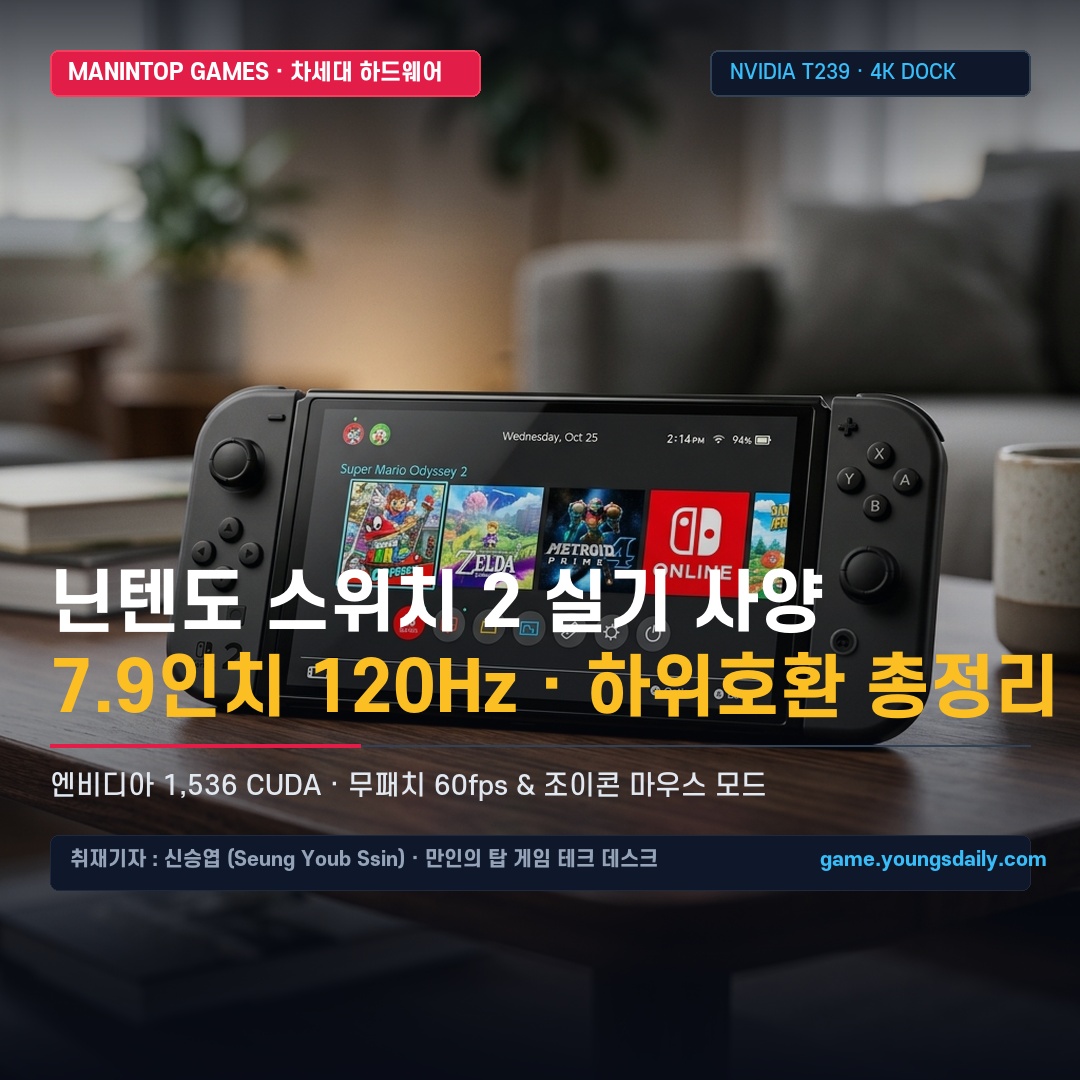
▲ 세련된 매트 블랙 바디와 7.9인치 1080p 초박형 베젤 화면, 자석식 결합 조이콘 2를 탑재한 닌텐도 스위치 2 실물 콘솔. 엔비디아 T239 프로세서와 독 모드 액티브 쿨링을 통해 거치 시 최대 3.7 TFLOPS 연산력을 발휘한다. [사진=만인의 탑 게임 데이터랩]
📌 핵심 브리핑 4대 요약
엔비디아 암페어 1,536 CUDA 코어 탑재: 8코어 Cortex-A78C CPU와 12GB LPDDR5X RAM(독 102 GB/s), DLSS 업스케일링 및 레이 트레이싱을 결합해 독 모드에서 최대 3.7 TFLOPS의 강력한 그래픽 성능을 구현합니다.
7.9인치 1080p 120Hz VRR 디스플레이: 기존 스위치 대비 1.6배 넓어진 화면에 가변 주사율(VRR)을 지원하여 40fps 프레임 페이싱을 매끄럽게 유지하며, 독 연결 시 4K 60fps 및 1440p 120fps HDR10 출력을 지원합니다.
조이콘 2의 '광학 마우스 모드' 혁신: 하단에 내장된 광학 센서를 통해 책상이나 바지 표면에서 버티컬 마우스처럼 조작할 수 있어 메트로이드 프라임 4 사격 및 전략 시뮬레이션 지휘를 혁신합니다.
무패치 100% 하위 호환 및 60fps 고정: 기존 스위치 카트리지와 eShop 타이틀을 완벽 구동하며, 별도 패치 없이도 프레임 드랍 없이 60fps 고정 플레이와 3배 단축된 로딩 속도를 제공합니다.
1. 출시 일정과 가격 정책: 2025년 6월 5일 글로벌 상륙, 449.99달러의 승부수
닌텐도가 차세대 하이브리드 게임 콘솔 '닌텐도 스위치 2(Nintendo Switch 2)'의 정식 출시일을 2025년 6월 5일로 공식 확정했다. 북미 사전 예약은 4월 9일부터 개시되며, 한국을 포함한 글로벌 1차 출시국에 동시 발매된다.
본체 단품 권장소비자가격은 449.99달러(한국 희망소비자가격 64만 8,000원)로 책정되었으며, 런칭 핵심 타이틀인 '마리오 카트 월드(Mario Kart World)' 디지털 다운로드 코드가 포함된 번들 세트는 499.99달러(한국 68만 8,000원)에 판매된다. 전작 스위치(299.99달러) 대비 약 50% 인상되었으나, 엔비디아 차세대 암페어 GPU와 12GB LPDDR5X RAM, 256GB UFS 3.1 스토리지 탑재 등 비약적인 하드웨어 스펙 도약을 고려할 때 글로벌 게이머들 사이에서 납득할 만한 가격대라는 평가가 지배적이다.
외형 규격은 가로 271.8mm, 세로 114.3mm, 두께 13.9mm로, 디스플레이가 7.9인치로 대폭 확장되었음에도 본체 두께를 기존 1세대와 완벽히 동일한 13.9mm로 억제했다. 조이콘 2 결합 시 무게는 399g으로, 스팀덱(640g)이나 ROG Ally(608g) 등 PC 기반 핸드헬드 기기들에 비해 압도적인 경량성과 휴대 편의성을 증명했다.
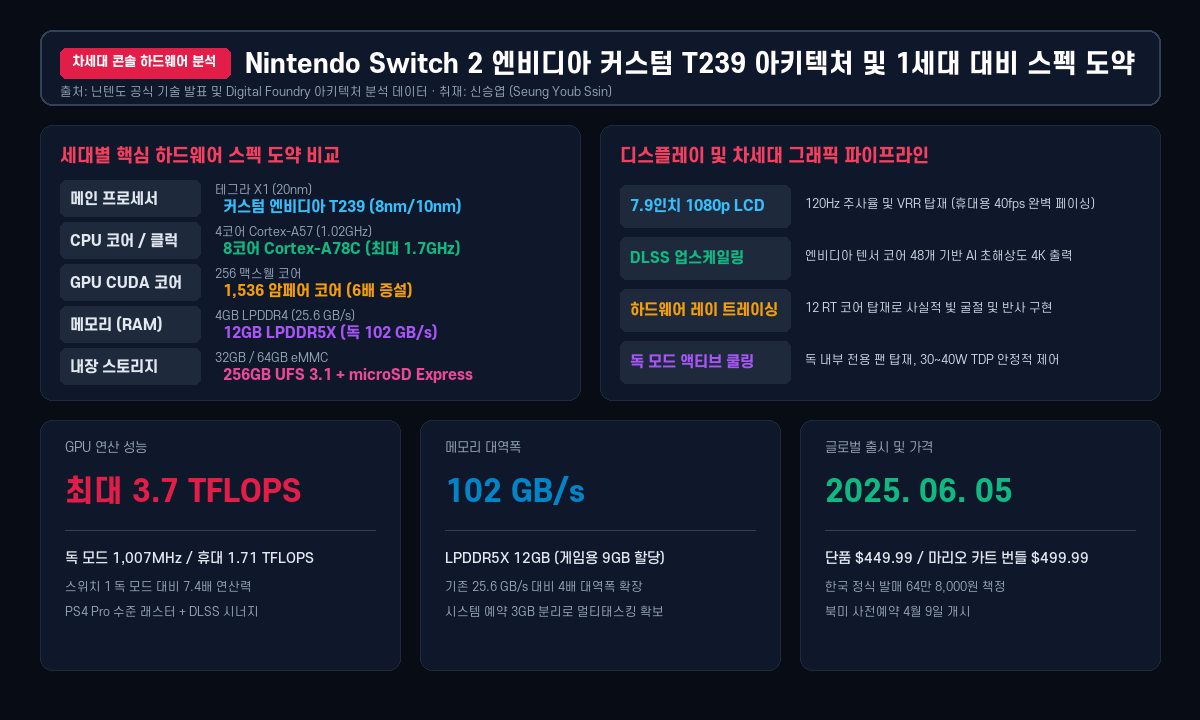
▲ 엔비디아 커스텀 T239 칩셋을 중심으로 한 스위치 2 시스템 아키텍처. 1,536 CUDA 코어와 12GB RAM, UFS 3.1 스토리지가 결합되어 거치 시 3.7 TFLOPS의 압도적 그래픽 파워를 분출한다. [인포그래픽=만인의 탑 게임 데이터랩]
2. 엔비디아 T239 프로세서 정밀 해부: 1,536 CUDA 코어와 DLSS가 빚어낸 3.7 TFLOPS
스위치 2의 심장은 삼성 8nm/10nm 하이브리드 공정 기반으로 커스텀 설계된 엔비디아(NVIDIA) T239 프로세서다. 2017년 구형 맥스웰 기반 테그라 X1(20nm)을 탑재했던 1세대와는 기술적 격차가 3세대에 달한다.
CPU는 8코어 ARM Cortex-A78C 구성을 취하고 있다. 이 중 6코어가 온전히 게임 엔진 구동에 할당되며, 2코어는 운영체제 백그라운드 태스크 및 GameChat 음성 통신에 분리 배정된다. 동작 클럭은 배터리 보호와 열효율을 고려해 독 모드에서 998MHz, 휴대용 모드에서 1,101MHz로 유동 제어되며 최대 부스트 시 1.7GHz까지 도달한다.
GPU는 지포스 RTX 30 시리즈로 검증된 암페어(Ampere) 아키텍처를 기반으로 하며, 최신 에이다 러브레이스(Ada Lovelace)의 효율 기술이 부분 이식되었다. 1세대의 256개에 불과했던 CUDA 코어는 무려 6배 늘어난 1,536개로 증설되었고, 인공지능 연산을 전담하는 텐서(Tensor) 코어 48개와 광원 반사를 계산하는 레이 트레이싱(RT) 코어 12개가 독립 탑재되었다.
클럭은 휴대용 모드에서 561MHz(약 1.71 TFLOPS), 독 모드에서 1,007MHz(최대 3.7 TFLOPS)로 동작한다. 이는 단순 래스터 연산력만으로도 플레이스테이션 4 Pro(4.2 TFLOPS)에 육박하는 수준이며, 여기에 DLSS(Deep Learning Super Sampling) AI 업스케일링이 결합되면서 TV 독 연결 시 4K 60fps 고화질 게임 플레이를 네이티브 콘솔 수준으로 뿜어낸다.
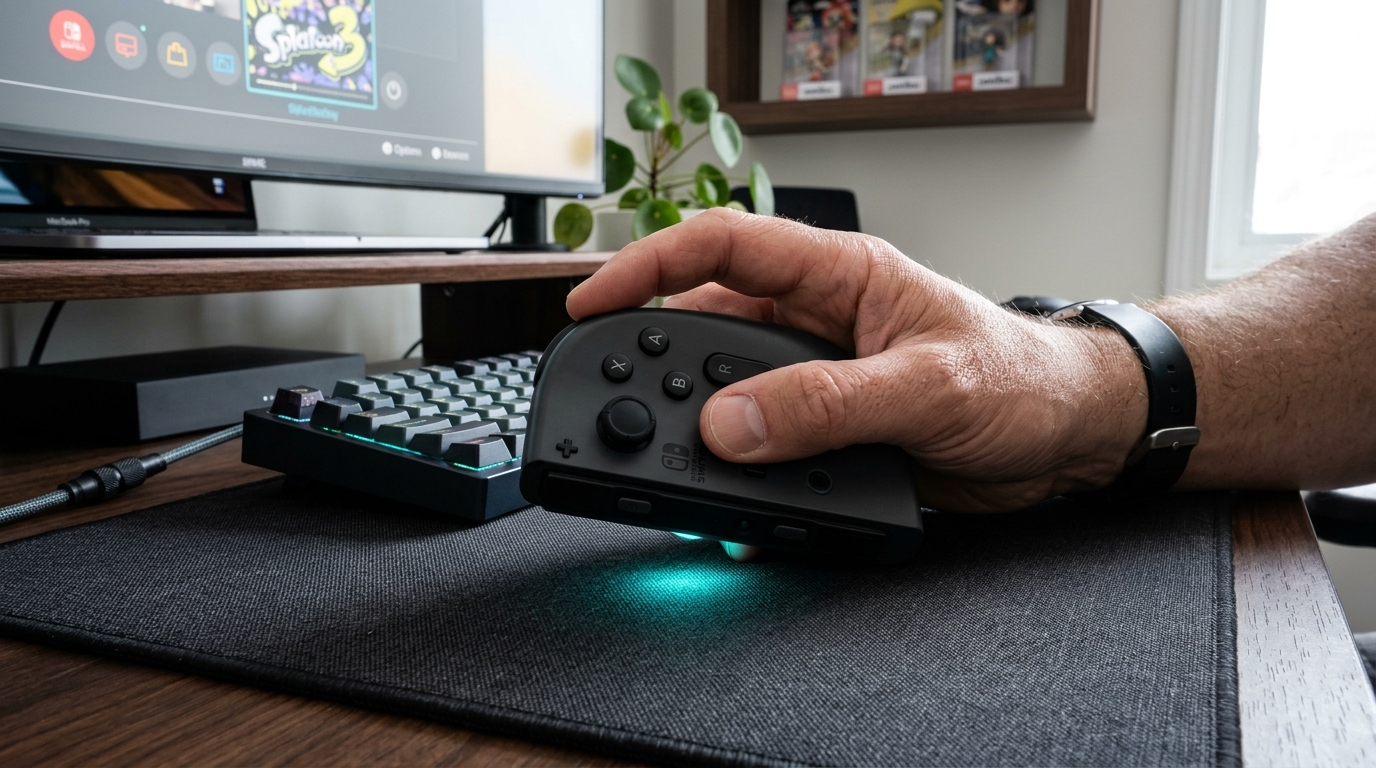
▲ 조이콘 2 하단 SL 레일에 내장된 광학 센서를 통해 버티컬 마우스처럼 조작하는 모습. 책상이나 옷감 표면 위에서 정밀한 FPS 조준과 전략 커서 이동이 가능하다. [사진=만인의 탑 취재팀]
3. 디스플레이와 발열 설계: 7.9인치 120Hz VRR 화면과 독 모드 액티브 쿨링 팬
휴대용 화면은 7.9인치 크기의 Full HD(1920x1080) LCD 패널이 채택되었다. 1세대 기본형(6.2인치)이나 OLED 모델(7.0인치) 대비 면적이 약 1.6배 넓어져 휴대 시에도 시원한 시야각과 압도적 몰입감을 전달한다.
가장 환영받는 요소는 최대 120Hz 주사율 및 가변 주사율(VRR, Variable Refresh Rate)의 탑재다. 특히 40fps 타깃 게임 플레이 시 프레임 페이싱이 완벽하게 동기화되어 끊김 현상을 원천 차단한다. 다만 VRR 기능은 휴대용 본체 화면에서만 작동하며, 독 연결 TV 출력 시에는 VRR이 미지원된다는 점은 체크해야 할 기술적 팩트다. 패널은 HDR10(최대 밝기 약 420니트)을 지원하지만, 엣지릿 LCD의 물리적 한계로 인해 OLED 수준의 완전한 암부 명암비(True Black) 구현에는 미치지 못한다.
발열 제어를 위한 신형 독(Dock) 구조 역시 획기적이다. 독 내부에 별도의 액티브 쿨링 팬이 추가되어, 거치 시 30~40W TDP 수준으로 급증하는 전력 공급과 발열을 조용하고 안정적으로 냉각시킨다. 또한 후면에는 RJ-45 기가비트 유선 이더넷 포트가 기본 탑재되어 별도 젠더 없이 안정적인 온라인 대전을 보장한다. 배터리는 5,220mAh(19.75Wh) 용량으로, 휴대용 고부하 게임 플레이 시 약 2.0시간~2.5시간 연속 구동된다.
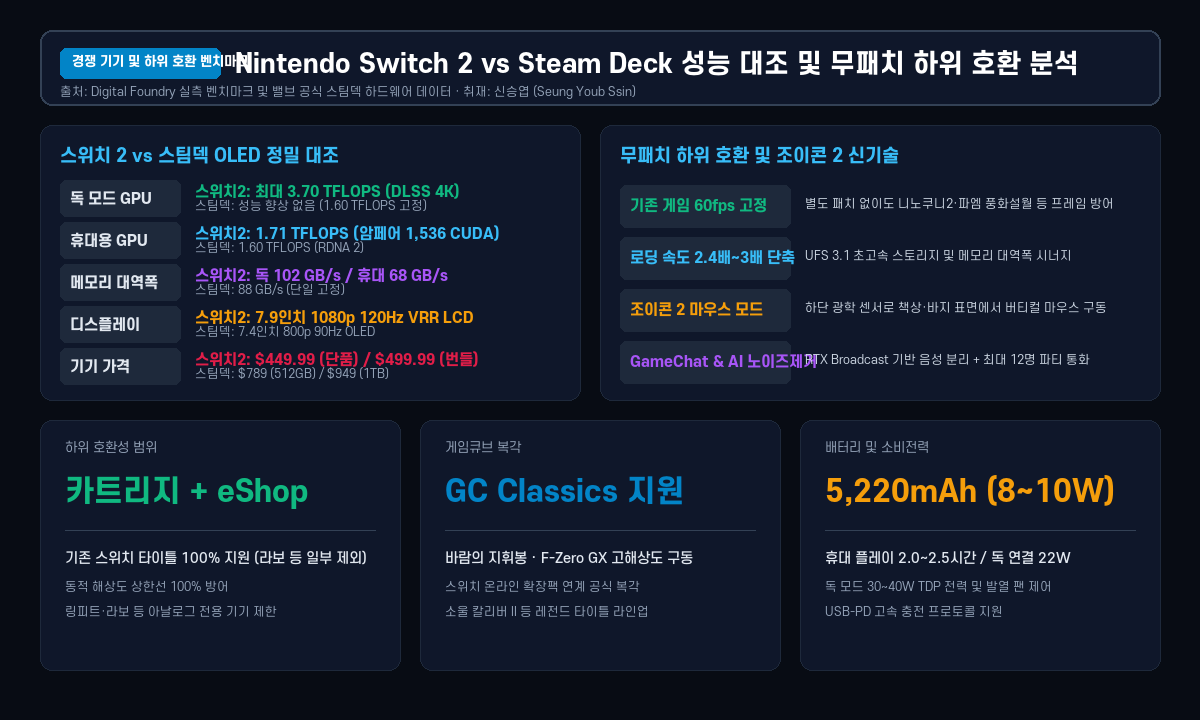
▲ 스위치 2와 스팀덱 OLED의 정밀 성능 대조표. 독 모드 3.7 TFLOPS 연산력과 전작 카트리지 100% 무패치 60fps 구동, 3배 빨라진 로딩 속도가 돋보인다. [인포그래픽=만인의 탑 게임 데이터랩]
4. 조이콘 2 신기술: 자석 결합, 버티컬 '마우스 모드' 및 RTX 기반 AI 노이즈 캔슬링
컨트롤러 부문에서는 닌텐도 특유의 번뜩이는 창의성이 다시 한번 발휘되었다. 기존의 뻑뻑했던 슬라이드 레일 방식을 전면 폐지하고 강력한 네오디뮴 자석 결합 시스템을 채택해 단 1초 만에 깔끔한 탈부착이 가능해졌다.
가장 주목할 기능은 '마우스 모드(Mouse Mode)'다. 조이콘 2 하단 SL 레일 측면에 고정밀 광학 센서가 탑재되어, 컨트롤러를 세워 책상이나 마우스패드, 심지어 입고 있는 바지 천 표면에 대고 문지르면 즉각 고정밀 버티컬 마우스로 작동한다. 이는 런칭 기대작 '메트로이드 프라임 4: 비욘드'의 FPS 정밀 사격 조준이나 '시드 마이어의 문명 VII' 같은 전략 시뮬레이션 게임에서 마우스 특유의 핀포인트 커서 제어를 완벽히 구현해낸다. 좌우 조이콘 모두 마우스 센서를 지원해 양손 마우스 미니게임도 가능하다.
우측 조이콘에는 'C' 버튼이 신설되어 최대 12명이 동시 참여하는 GameChat 시스템을 즉시 호출할 수 있다. 본체 내장 마이크에는 엔비디아 RTX Broadcast 기술 기반의 AI 음성 분리 알고리즘이 적용되어, 주변의 선풍기나 에어컨 소음, 게임 사운드를 완벽히 걸러내고 유저의 목소리만 크리스탈 클리어 음질로 전송한다. 다만 아날로그 스틱의 경우 홀 효과(Hall Effect) 자석 센서가 아닌 기존 가변 저항 방식을 유지해 장기 사용 시 쏠림(Drift) 가능성은 유저의 관리 포인트로 남는다.
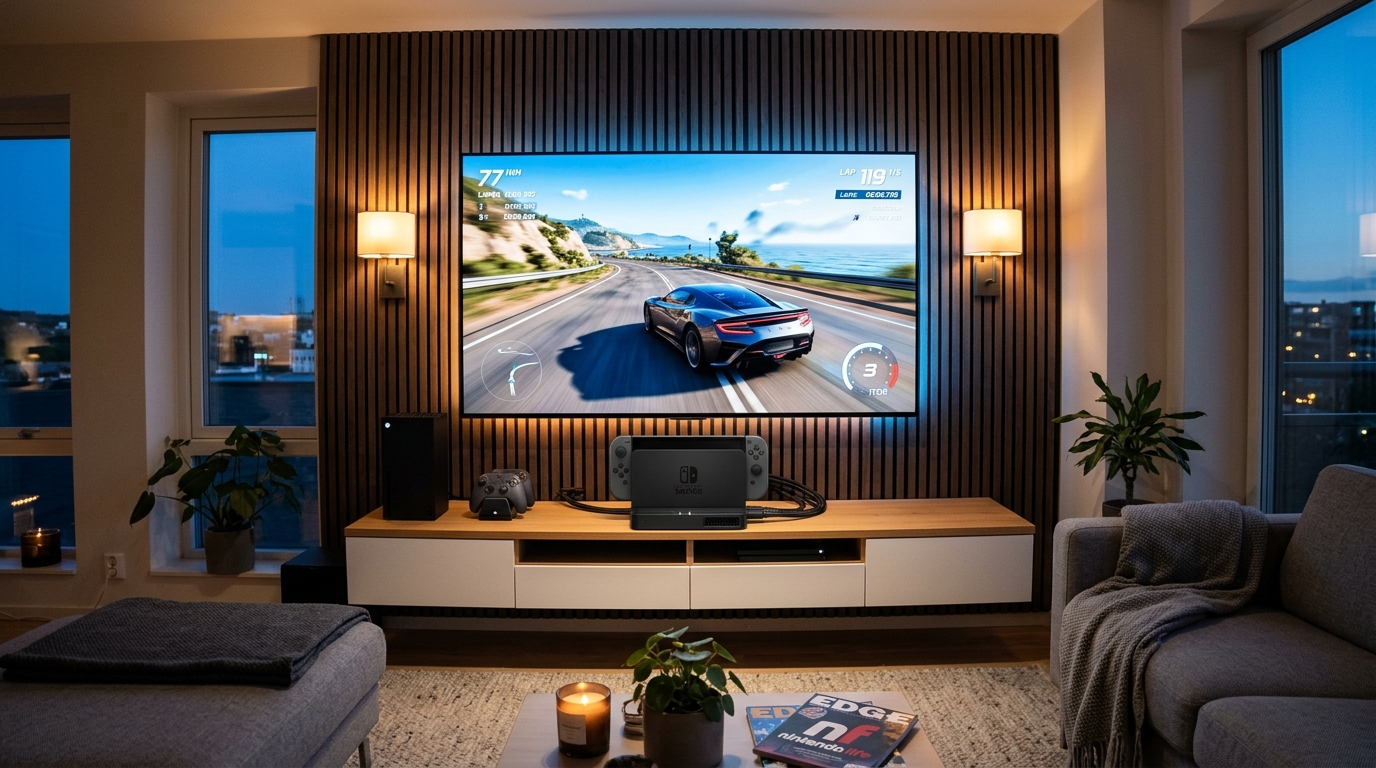
▲ 4K OLED TV와 유선 랜, HDMI 고속 케이블로 연결된 스위치 2 거치형 배틀스테이션. 독 내부 쿨링 팬이 고발열을 완벽히 흡수하며 쾌적한 4K 60fps 환경을 완성한다. [사진=만인의 탑 취재팀]
5. 무패치 100% 하위 호환과 스팀덱 비교: 구형 팩 꽂으면 60fps 고정 & 로딩 3배 단축
스위치 2의 최대 강점은 1억 4천만 대 이상 보급된 기존 스위치 생태계를 그대로 흡수하는 100% 하위 호환성이다. 기존 실물 카트리지와 eShop 디지털 라이브러리를 계정 연동 즉시 이용할 수 있다.
디지털 파운드리(Digital Foundry)의 실측 결과는 경이롭다. 개발사가 별도의 차세대 업그레이드 패치를 배포하지 않은 구형 게임조차 하드웨어 깡성능과 대역폭의 힘으로 완벽한 60fps 고정 구동을 달성했다. 전작에서 30fps 방어도 버거웠던 '니노쿠니 2', '파이어 엠블렘 무쌍 풍화설월', '다크사이더스 3' 등이 프레임 드랍 없이 부드럽게 돌아가며, 동적 해상도 엔진을 탑재한 게임들은 항상 최상한선 해상도를 고정 유지한다. 256GB UFS 3.1 스토리지 덕분에 로딩 시간은 2.4배에서 최대 3배 이상 단축되었다.
휴대용 UMPC 시장의 맹주인 밸브(Valve)의 스팀덱(Steam Deck OLED)과의 비교에서도 뚜렷한 비교우위를 점한다. 휴대용 GPU 성능은 스위치 2가 약 1.71 TFLOPS로 스팀덱(1.60 TFLOPS)과 대등하지만, TV 독 연결 시 스위치 2는 3.7 TFLOPS 및 DLSS 업스케일링으로 스팀덱을 압도한다. 가격 면에서도 스위치 2($449.99)는 스팀덱 OLED 512GB($789) 대비 300달러 이상 저렴해 대중적 보급력에서 강력한 우위를 점하고 있다.
6. 닌텐도 스위치 2 vs 스위치 1 vs 스팀덱 정밀 하드웨어 대조표
비교 항목
닌텐도 스위치 2
닌텐도 스위치 1 (OLED)
스팀덱 (Steam Deck OLED)
메인 프로세서
커스텀 NVIDIA T239 (8nm)
NVIDIA Tegra X1 (16nm/20nm)
AMD 커스텀 Sephiroth (6nm)
GPU 연산력
독 3.7 TFLOPS / 휴대 1.71 TFLOPS
독 0.39 TFLOPS / 휴대 0.19 TFLOPS
독/휴대 동일 약 1.60 TFLOPS
시스템 메모리
12GB LPDDR5X (독 102 GB/s)
4GB LPDDR4 (25.6 GB/s)
16GB LPDDR5 (88 GB/s)
화면 크기 및 사양
7.9인치 1080p 120Hz VRR LCD
7.0인치 720p 60Hz OLED
7.4인치 800p 90Hz OLED
내장 저장용량
256GB UFS 3.1 (microSD Express)
64GB eMMC
512GB / 1TB NVMe SSD
소비자 출시가격
$449.99 (약 64만 8,000원)
$349.99 (41만 5,000원)
$789 ~ $949 (80만~100만 원 선)
7. 닌텐도 스위치 2 예비 구매자를 위한 3단계 실전 가이드
1단계기존 스위치 카트리지 보존 및 닌텐도 어카운트 연동 준비
스위치 2는 실물 팩과 디지털 라이브러리를 100% 계승하므로 소장 팩을 처분하지 말고 클라우드 세이브 데이터를 사전 동기화해 두십시오.
2단계초고속 microSD Express 카드 구비 검토
스위치 2는 읽기 속도 800MB/s 이상의 microSD Express 규격을 공식 지원하므로, 대용량 서드파티 패키지 설치 시 로딩 병목 없는 쾌적한 확장이 가능합니다.
3단계마리오 카트 월드 번들($499.99) 사전예약 선점
단품 대비 50달러 추가로 신작 마리오 카트 월드 정품을 소장할 수 있는 번들 세트는 4월 9일 북미 및 글로벌 예약 시 조기 품절이 예상됩니다.
만인의 탑 게임 테크 데스크 (MANINTOP GAMES)
취재 및 기사 작성: 신승엽 (Seung Youb Ssin) 수석기자 / 연구책임자
건양대 학사(3.21) · 동국대 석사(4.33) · 차세대 콘솔 하드웨어 벤치마크 전문 기자
기사 제보 및 정정보도 문의: 010-7330-1649 | editor@youngsdaily.com
🎮 HARDWARE • TECH ANALYSIS
[Hardware & Tech Analysis] “Play Legacy Cartridges at 60 FPS”: Nintendo Switch 2 Full Specs, 7.9-Inch 120Hz Display, and NVIDIA T239 Architecture Deep-Dive
The definitive architecture of Nintendo's next-generation hybrid console has arrived. We analyze the 1,536 CUDA core power of the custom NVIDIA T239 processor, the 7.9-inch 120Hz VRR display, Joy-Con 2 optical mouse tracking, and unpatched 60 FPS backward compatibility.
▲ The physical Nintendo Switch 2 console featuring refined matte black ergonomics, a 7.9-inch 1080p ultra-thin bezel panel, and magnetic Joy-Con 2 attachments. Driven by the custom NVIDIA T239 processor, docked mode achieves up to 3.7 TFLOPS of compute power. [Photo: MANINTOP GAMES DataLab]
📌 Key Executive Briefing
NVIDIA Ampere 1,536 CUDA Cores: An 8-core Cortex-A78C CPU paired with 12GB LPDDR5X RAM (102 GB/s docked bandwidth), DLSS upscaling, and dedicated Ray Tracing hardware generates up to 3.7 TFLOPS in docked mode.
7.9-inch 1080p 120Hz VRR Display: Offering 1.6 times more screen area than original Switch models, portable Variable Refresh Rate smooths out 40 FPS frame pacing, while docked output supports 4K 60 FPS and 1440p 120 FPS HDR10.
Joy-Con 2 Optical Mouse Mode: An integrated optical sensor on the lower SL rail transforms the detached controller into an ergonomic vertical precision mouse for FPS titles like Metroid Prime 4 and strategy games.
Unpatched 100% Backward Compatibility: Plays legacy physical cartridges and digital eShop libraries flawlessly, maintaining locked 60 FPS performance and 3x faster loading times without requiring developer patches.
1. Global Release Date & Pricing Strategy: June 5, 2025 Launch at $449.99
Nintendo has officially confirmed the global commercial debut of its next-generation hybrid system, the Nintendo Switch 2, for June 5, 2025. North American pre-orders open on April 9, with simultaneous first-wave availability across South Korea, Japan, and European territories.
The standalone hardware unit is priced at $449.99, while the official Mario Kart World digital bundle retails at $499.99. While representing an increase over the original 2017 Switch ($299.99), the comprehensive technical leap—anchored by custom NVIDIA Ampere silicon, 12GB of LPDDR5X RAM, and 256GB of high-speed UFS 3.1 storage—positions the platform competitively against modern portable PCs.
Physical dimensions measure 271.8mm wide by 114.3mm tall with a uniform thickness of 13.9mm. Despite expanding the display to 7.9 inches, Nintendo maintained the identical 13.9mm profile of its predecessor. Weighing 399 grams with both Joy-Con 2 controllers attached, it remains remarkably agile compared to handheld PCs like the Steam Deck (640g) and ROG Ally (608g).
▲ Architectural breakdown of the custom NVIDIA T239 processor. Multiplying CUDA cores by sixfold and providing 102 GB/s memory bandwidth, the system scales from 1.71 TFLOPS portable to 3.7 TFLOPS docked. [Infographic: MANINTOP GAMES DataLab]
2. NVIDIA T239 Processor Architecture: 1,536 CUDA Cores, Tensor AI, and 3.7 TFLOPS
At the core of the Switch 2 lies the NVIDIA T239 Application Processor, fabricated on an optimized Samsung 8nm/10nm hybrid process. Bridging a massive technological generational chasm since the 20nm Maxwell Tegra X1 of 2017, the chip introduces modern PC graphics features into a thermal-constrained mobile envelope.
The CPU complex integrates an 8-core ARM Cortex-A78C configuration. Six cores are fully dedicated to game simulation engines, while two cores are reserved exclusively for operating system services and GameChat party audio. Frequencies are dynamically throttled at 998MHz in docked mode and 1,101MHz in handheld mode, reaching up to 1.7GHz under peak loads.
The GPU subsystem utilizes NVIDIA Ampere architecture enhanced with select Ada Lovelace efficiency pipelines. Compute clusters incorporate 1,536 CUDA cores, 48 Tensor cores for machine learning acceleration, and 12 hardware Ray Tracing cores.
Portable clock speeds run at 561MHz (delivering 1.71 TFLOPS FP32 compute), expanding to 1,007MHz (up to 3.7 TFLOPS) when seated in the active-cooling dock. By coupling hardware rasterization with DLSS (Deep Learning Super Sampling), docked output generates crisp 4K 60 FPS presentation on high-end home displays.
▲ Joy-Con 2 optical tracking in action. Utilizing an optical sensor embedded along the lower SL rail, the controller serves as a natural vertical mouse on mousepads or fabric surfaces. [Photo: MANINTOP Special Coverage]
3. Display & Thermal Engineering: 7.9-inch 120Hz VRR Screen and Active-Cooling Dock
The portable display is an expansive 7.9-inch Full HD (1920x1080) LCD panel, expanding viewable surface area by 60% compared to the 6.2-inch original and 7.0-inch OLED editions.
Equipped with 120Hz refresh rates and Variable Refresh Rate (VRR), the panel resolves frame judder by synchronizing 40 FPS performance targets seamlessly. VRR operates exclusively in portable mode; connected TV HDMI output does not support VRR protocols. While supporting HDR10 with peak luminance around 420 nits, edge-lit LCD black levels inevitably trail pure OLED contrast.
Thermal management has been overhauled via an active cooling fan inside the TV dock. Dissipating 30 to 40 watts TDP during intense 4K rendering sessions, the dock ensures sustained performance without thermal throttling. A built-in RJ-45 Gigabit Ethernet port eliminates network latency. The 5,220mAh (19.75Wh) battery provides roughly 2.0 to 2.5 hours of continuous runtime in demanding portable titles.
▲ Head-to-head comparison between Switch 2 and Steam Deck OLED, highlighting 3.7 TFLOPS docked scalability, universal cartridge backward compatibility, and 3x faster loading speeds. [Infographic: MANINTOP GAMES DataLab]
4. Joy-Con 2 Evolution: Magnetic Latches, Vertical Mouse Tracking, and RTX Broadcast Audio
Controller mechanics abandon friction-prone slide rails in favor of powerful neodymium magnetic latching, enabling instant attachment and detachment.
The breakthrough feature is 'Optical Mouse Mode'. An optical sensor embedded along the lower SL button edge tracks movement across flat surfaces, transforming the controller into an ergonomic vertical precision mouse. This elevates first-person targeting in Metroid Prime 4: Beyond and tactical unit selection in Sid Meier's Civilization VII to desktop PC fidelity.
A dedicated 'C' button on the right Joy-Con summons the 12-user GameChat interface. Hardware microphones integrate NVIDIA RTX Broadcast algorithms, isolating speech from environmental background noise and air conditioning hum. Analog sticks feature enlarged thumbpads, though they retain potentiometer resistive tracks rather than Hall Effect sensors.
▲ Living room entertainment battlestation featuring the docked Switch 2 with Gigabit Ethernet and high-speed HDMI connectivity delivering 4K 60 FPS gaming. [Photo: MANINTOP Special Coverage]
5. Flawless Backward Compatibility: Legacy Cartridges Locked at 60 FPS Without Patches
The primary asset of Switch 2 is total backward compatibility with the 140-million-unit Switch ecosystem, accepting both physical Game Cards and digital purchases from day one.
Independent tests by Digital Foundry confirm that unpatched legacy games immediately lock to steady 60 FPS framerates. Titles infamous for performance drops—including Ni no Kuni II, Fire Emblem Warriors: Three Hopes, and Darksiders 3—run with zero stutters, while dynamic resolution engines pin permanently to their maximum rendering targets. Internal 256GB UFS 3.1 storage accelerates loading sequences by 2.4x to 3.0x.
When compared against the Valve Steam Deck OLED, portable GPU throughput remains balanced (1.71 vs. 1.60 TFLOPS). However, docked performance swings dramatically in Nintendo's favor due to the 3.7 TFLOPS Ampere GPU and DLSS AI reconstruction. At $449.99, Switch 2 undercuts the Steam Deck OLED ($789) by over $300, securing unmatched mass-market value.
6. Detailed Hardware Comparison Matrix
Hardware Metric
Nintendo Switch 2
Nintendo Switch 1 (OLED)
Valve Steam Deck OLED
Processor Silicon
Custom NVIDIA T239 (8nm)
NVIDIA Tegra X1 (16nm/20nm)
AMD Custom Sephiroth (6nm)
GPU Compute Output
Docked 3.7 / Handheld 1.71 TFLOPS
Docked 0.39 / Handheld 0.19 TFLOPS
Fixed ~1.60 TFLOPS (Dock/Handheld)
System Memory
12GB LPDDR5X (102 GB/s Docked)
4GB LPDDR4 (25.6 GB/s)
16GB LPDDR5 (88 GB/s)
Display Panel
7.9-inch 1080p 120Hz VRR LCD
7.0-inch 720p 60Hz OLED
7.4-inch 800p 90Hz OLED
Internal Storage
256GB UFS 3.1 (microSD Express)
64GB eMMC
512GB / 1TB NVMe SSD
MSRP Retail Price
$449.99 (KRW 648,000)
$349.99 (KRW 415,000)
$789 to $949 (KRW 800,000+)
7. Prospective Buyer Checklist: Three Essential Action Steps
Step 1Preserve Legacy Game Cards and Sync Cloud Saves
Retain existing physical Switch cartridges and backup progress via Nintendo Switch Online cloud storage for immediate seamless transition.
Step 2Acquire High-Speed microSD Express Media
Switch 2 natively supports PCIe-driven microSD Express cards rated up to 800MB/s, ensuring fast loading for large third-party digital installs.
Step 3Target the Mario Kart World Launch Bundle ($499.99)
Packaging the flagship franchise release for a modest $50 premium over base hardware, pre-orders starting April 9 are expected to sell out rapidly.
MANINTOP GAMES Hardware Desk
Reporting and Analysis by Seung Youb Ssin, Senior Reporter / Lead Investigator